Denudation, which has been occasionally spoken of in the preceding chapters, is
the removal of solid matter by water in motion, whether of rivers or of the
waves and currents of the sea, and the consequent laying bare of some inferior
rock. This operation has exerted an influence on the structure of the earth’s
crust as universal and important as sedimentary deposition itself; for
denudation is the necessary antecedent of the production of all new strata of
mechanical origin. The formation of every new deposit by the transport of
sediment and pebbles necessarily implies that there has been, somewhere else, a
grinding down of rock into rounded fragments, sand, or mud, equal in quantity to
the new strata. All deposition, therefore, except in the case of a shower of
volcanic ashes, and the outflow of lava, and the growth of certain organic
formations, is the sign of superficial waste going on contemporaneously, and to
an equal amount, elsewhere. The gain at one point is no more than sufficient to
balance the loss at some other. Here a lake has grown shallower, there a ravine
has been deepened. Here the depth of the sea has been augmented by the removal
of a sandbank during a storm, there its bottom has been raised and shallowed by
the accumulation in its bed of the same sand transported from the bank.
When we see a stone building, we know that somewhere, far or near, a quarry has
been opened. The courses of stone in the building may be compared to successive
strata, the quarry to a ravine or valley which has suffered denudation. As the
strata, like the courses of hewn stone, have been laid one upon another
gradually, so the excavation both of the valley and quarry have been gradual. To
pursue the comparison still farther, the superficial heaps of mud, sand, and
gravel, usually called alluvium, may be likened to the rubbish of a quarry which
has been rejected as useless by the workmen, or has fallen upon the road between
the quarry and the building, so as to lie scattered at random over the ground.
But we occasionally find in a conglomerate large rounded pebbles of an older
conglomerate, which had previously been derived from a variety of different
rocks. In such cases we are reminded that, the same materials having been used
over and over again, it is not enough to affirm that the entire mass of
stratified deposits in the earth’s crust affords a monument and measure of the
denudation which has taken place, for in truth the quantity of matter now extant
in the form of stratified rock represents but a fraction of the material removed
by water and redeposited in past ages.
Subaërial Denudation.—Denudation may be divided into subaërial, or the
action of wind, rain, and rivers; and submarine, or that effected by the waves
of the sea, and its tides and currents. With the operation of the first of these
we are best acquainted, and it may be well to give it our first attention.
Action of the Wind.—In desert regions where no rain falls, or where, as
in parts of the Sahara, the soil is so salt as to be without any covering of
vegetation, clouds of dust and sand attest the power of the wind to cause the
shifting of the unconsolidated or disintegrated rock.
In examining volcanic countries I have been much struck with the great
superficial changes brought about by this power in the course of centuries. The
highest peak of Madeira is about 6050 feet above the sea, and consists of the
skeleton of a volcanic cone now 250 feet high, the beds of which once dipped
from a centre in all directions at an angle of more than 30°. The summit is
formed of a dike of basalt with much olivine, fifteen feet wide, apparently the
remains of a column of lava which once rose to the crater. Nearly all the scoriæ
of the upper part of the cone have been swept away, those portions only
remaining which were hardened by the contact or proximity of the dike. While I
was myself on this peak on January 25, 1854, I saw the wind, though it was not
stormy weather, removing sand and dust derived from the decomposing scoriæ.
There had been frost in the night, and some ice was still seen in the crevices
of the rock.
On the highest platform of the Grand Canary, at an elevation of 6000 feet, there
is a cylindrical column of hard lava, from which the softer matter has been
carried away; and other similar remnants of the dikes of cones of eruption
attest the denuding power of the wind at points where running water could never
have exerted any influence. The waste effected by wind aided by frost and snow,
may not be trifling, even in a single winter, and when multiplied by centuries
may become indefinitely great.
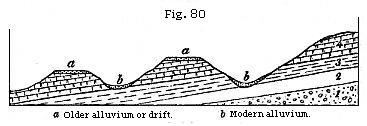
Action of Running Water.—There are different classes of phenomena which
attest in a most striking manner the vast spaces left vacant by the erosive
power of water. I may allude, first, to those valleys on both sides of which the
same strata are seen following each other in the same order, and having the same
mineral composition and fossil contents. We may observe, for example, several
formations, as Nos. 1, 2, 3, 4, in the diagram (Fig. 80): No. 1, conglomerate,
No. 2, clay, No. 3, grit, and No. 4, limestone, each repeated in a series of
hills separated by valleys varying in depth. When we examine the subordinate
parts of these four formations, we find, in like manner, distinct beds in each,
corresponding, on the opposite sides of the valleys, both in composition and
order of position. No one can doubt that the strata were originally continuous,
and that some cause has swept away the portions which once connected the whole
series. A torrent on the side of a mountain produces similar interruptions; and
when we make artificial cuts in lowering roads, we expose, in like manner,
corresponding beds on either side. But in nature, these appearances occur in
mountains several thousand feet high, and separated by intervals of many miles
or leagues in extent.
In the “Memoirs of the Geological Survey of Great Britain” (vol. i), Professor
Ramsay has shown that the missing beds, removed from the summit of the Mendips,
must have been nearly a mile in thickness; and he has pointed out considerable
areas in South Wales and some of the adjacent counties of England, where a
series of primary (or palæozoic) strata, no less than 11,000 feet in thickness,
have been stripped off. All these materials have of course been transported to
new regions, and have entered into the composition of more modern formations. On
the other hand, it is shown by observations in the same “Survey,” that the
Palæozoic strata are from 20,000 to 30,000 feet thick. It is clear that such
rocks, formed of mud and sand, now for the most part consolidated, are the
monuments of denuding operations, which took place on a grand scale at a very
remote period in the earth’s history. For, whatever has been given to one area
must always have been borrowed from another; a truth which, obvious as it may
seem when thus stated, must be repeatedly impressed on the student’s mind,
because in many geological speculations it is taken for granted that the
external crust of the earth has been always growing thicker in consequence of
the accumulation, period after period, of sedimentary matter, as if the new
strata were not always produced at the expense of pre-existing rocks, stratified
or unstratified. By duly reflecting on the fact that all deposits of mechanical
origin imply the transportation from some other region, whether contiguous or
remote, of an equal amount of solid matter, we perceive that the stony exterior
of the planet must always have grown thinner in one place, whenever, by
accessions of new strata, it was acquiring thickness in another.
It is well known that generally at the mouths of large rivers, deltas are
forming and the land is encroaching upon the sea; these deltas are monuments of
recent denudation and deposition; and it is obvious that if the mud, sand, and
gravel were taken from them and restored to the continents they would fill up a
large part of the gullies and valleys which are due to the excavating and
transporting power of torrents and rivers.
Alluvium.—Between the superficial covering of vegetable mould and the
subjacent rock there usually intervenes in every district a deposit of loose
gravel, sand, and mud, to which when it occurs in valleys the name of alluvium
has been popularly applied. The term is derived from alluvio,
an inundation, oralluo, to wash, because the pebbles and sand commonly
resemble those of a river’s bed or the mud and gravel washed over low lands by a
flood.
In the course of those changes in physical geography which may take place during
the gradual emergence of the bottom of the sea and its conversion into dry land,
any spot may either have been a sunken reef, or a bay, or estuary, or sea-shore,
or the bed of a river. The drainage, moreover, may have been deranged again and
again by earthquakes, during which temporary lakes are caused by landslips, and
partial deluges occasioned by the bursting of the barriers of such lakes. For
this reason it would be unreasonable to hope that we should ever be able to
account for all the alluvial phenomena of each particular country, seeing that
the causes of their origin are so various. Besides, the last operations of water
have a tendency to disturb and confound together all pre-existing alluviums.
Hence we are always in danger of regarding as the work of a single era, and the
effect of one cause, what has in reality been the result of a variety of
distinct agents, during a long succession of geological epochs. Much useful
instruction may therefore be gained from the exploration of a country like
Auvergne, where the superficial gravel of very different eras happens to have
been preserved and kept separate by sheets of lava, which were poured out one
after the other at periods when the denudation, and probably the upheaval, of
rocks were in progress. That region had already acquired in some degree its
present configuration before any volcanoes were in activity, and before any
igneous matter was superimposed upon the granitic and fossiliferous formations.
The pebbles therefore in the older gravels are exclusively constituted of
granite and other aboriginal rocks; and afterwards, when volcanic vents burst
forth into eruption, those earlier alluviums were covered by streams of lava,
which protected them from intermixture with gravel of subsequent date. In the
course of ages, a new system of valleys was excavated, so that the rivers ran at
lower levels than those at which the first alluviums and sheets of lava were
formed. When, therefore, fresh eruptions gave rise to new lava, the melted
matter was poured out over lower grounds; and the gravel of these plains
differed from the first or upland alluvium, by containing in it rounded
fragments of various volcanic rocks, and often fossil bones belonging to species
of land animals different from those which had previously flourished in the same
country and been buried in older gravels.
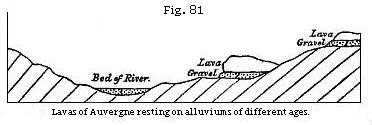
The annexed drawing (Fig. 81) will explain the different heights at which beds
of lava and gravel, each distinct from the other in composition and age, are
observed, some on the flat tops of hills, 700 or 800 feet high, others on the
slope of the same hills, and the newest of all in the channel of the existing
river where there is usually gravel alone, although in some cases a narrow strip
of solid lava shares the bottom of the valley with the river.
The proportion of extinct species of quadrupeds is more numerous in the fossil
remains of the gravel No. 1 than in that indicated as No. 2; and in No. 3 they
agree more closely, sometimes entirely, with those of the existing fauna. The
usual absence or rarity of organic remains in beds of loose gravel and sand is
partly owing to the friction which originally ground down the rocks into small
fragments, and partly to the porous nature of alluvium, which allows the free
percolation through it of rain-water, and promotes the decomposition and removal
of fossil remains.
The loose transported matter on the surface of a large part of the land now
existing in the temperate and arctic regions of the northern hemisphere, must be
regarded as being in a somewhat exceptional state, in consequence of the
important part which ice has played in comparatively modern geological times.
This subject will be more specially alluded to when we describe, in the eleventh
chapter, the deposits called “glacial.”
Denuding Power of Rivers affected by Rise or Fall of Land.—It has long
been a matter of common observation that most rivers are now cutting their
channels through alluvial deposits of greater depth and extent than could ever
have been formed by the present streams. From this fact it has been inferred
that rivers in general have grown smaller, or become less liable to be flooded
than formerly. It may be true that in the history of almost every country the
rivers have been both larger and smaller than they are at the present moment.
For the rainfall in particular regions varies according to climate and physical
geography, and is especially governed by the elevation of the land above the
sea, or its distance from it and other conditions equally fluctuating in the
course of time. But the phenomenon alluded to may sometimes be accounted for by
oscillations in the level of the land, experienced since the existing valleys
originated, even where no marked diminution in the quantity of rain and in the
size of the rivers has occurred.
We know that many large areas of land are rising and others sinking, and unless
it could be assumed that both the upward and downward movements are everywhere
uniform, many of the existing hydrographical basins ought to have the appearance
of having been temporary lakes first filled with fluviatile strata and then
partially re-excavated. Suppose, for example, part of a continent, comprising
within it a large hydrographical basin like that of the Mississippi, to subside
several inches or feet in a century, as the west coast of Greenland, extending
600 miles north and south, has been sinking for three or four centuries, between
the latitudes 60° and 69° N.1
It will rarely happen that the rate of subsidence will be everywhere
equal, and in many cases the amount of depression in the interior will regularly
exceed that of the region nearer the sea. Whenever this happens, the fall of the
waters flowing from the upland country will be diminished, and each tributary
stream will have less power to carry its sand and sediment into the main river,
and the main river less power to convey its annual burden of transported matter
to the sea. All the rivers, therefore, will proceed to fill up partially their
ancient channels, and, during frequent inundations, will raise their alluvial
plains by new deposits. If then the same area of land be again upheaved to its
former height, the fall, and consequently the velocity, of every river will
begin to augment. Each of them will be less given to overflow its alluvial
plain; and their power of carrying earthy matter seaward, and of scouring out
and deepening their channels, will be sustained till, after a lapse of many
thousand years, each of them has eroded a new channel or valley through a
fluviatile formation of comparatively modern date. The surface of what was once
the river-plain at the period of greatest depression, will then remain fringing
the valley-sides in the form of a terrace apparently flat, but in reality
sloping down with the general inclination of the river. Everywhere this terrace
will present cliffs of gravel and sand, facing the river. That such a series of
movements has actually taken place in the main valley of the Mississippi and in
its tributary valleys during oscillations of level, I have endeavoured to show
in my description of that country;2
and the fresh-water shells of existing species and bones of land
quadrupeds, partly of extinct races, preserved in the terraces of fluviatile
origin, attest the exclusion of the sea during the whole process of filling up
and partial re-excavation.
Littoral Denudation.—Part of the action of the waves between high and low
watermark must be included in subaërial denudation, more especially as the
undermining of cliffs by the waves is facilitated by land-springs, and these
often lead to the sliding down of great masses of land into the sea. Along our
coasts we find numerous submerged forests, only visible at low water, having the
trunks of the trees erect and their roots attached to them and still spreading
through the ancient soil as when they were living. They occur in too many
places, and sometimes at too great a depth, to be explained by a mere change in
the level of the tides, although as the coasts waste away and alter in shape,
the height to which the tides rise and fall is always varying, and the level of
high tide at any given point may, in the course of many ages, differ by several
feet or even fathoms. It is this fluctuation in the height of the tides, and the
erosion and destruction of the sea-coast by the waves, that makes it exceedingly
difficult for us in a few centuries, or even perhaps in a few thousand years, to
determine whether there is a change by subterranean movement in the relative
level of sea and land.
We often behold, as on the coasts of Devonshire and Pembrokeshire, facts which
appear to lead to opposite conclusions. In one place a raised beach with marine
littoral shells, and in another immediately adjoining a submerged forest. These
phenomena indicate oscillations of level, and as the movements are very gradual,
they must give repeated opportunities to the breakers to denude the land which
is thus again and again exposed to their fury, although it is evident that the
submergence is sometimes effected in such a manner as to allow the trees which
border the coast not to be carried away.
Inland Sea-cliffs.—In countries where hard limestone rocks abound, inland
cliffs have often retained faithfully for ages the characters which they
acquired when they constituted the boundary of land and sea. Thus, in the Morea,
no less than three or even four ranges of cliffs are well-preserved, rising one
above the other at different distances from the actual shore, the summit of the
highest and oldest occasionally attaining 1000 feet in elevation. A consolidated
beach with marine shells is usually found at the base of each cliff, and a line
of littoral caverns. These ranges of cliff probably imply pauses in the process
of upheaval when the waves and currents had time to undermine and clear away
considerable masses of rock.
But the beginner should be warned not to expect to find evidence of the former
sojourn of the sea on all those lands which we are nevertheless sure have been
submerged at periods comparatively modern; for notwithstanding the enduring
nature of the marks left by littoral action on some rocks, especially
limestones, we can by no means detect sea-beaches and inland cliffs everywhere.
On the contrary, they are, upon the whole, extremely partial, and are often
entirely wanting in districts composed of argillaceous and sandy formations,
which must, nevertheless, have been upheaved at the same time, and by the same
intermittent movements, as the adjoining harder rocks.
Escarpments.—Besides the inland cliffs above alluded to which mark the
ancient limits of the sea, there are other abrupt terminations of rocks of
various kinds which resemble sea-cliffs, but which have in reality been due to
subaërial denudation. These have been called “escarpments,” a term which it is
useful to confine to the outcrop of particular formations having a scarped
outline, as distinct from cliffs due to marine action.
I formerly supposed that the steep line of cliff-like slopes seen along the
outcrop of the chalk, when we follow the edge of the North or South Downs, was
due to marine action; but Professor Ramsay has shown3
that the present outline of the physical geography is more in favour of
the idea of the escarpments having been due to gradual waste since the rocks
were exposed in the atmosphere to the action of rain and rivers.
Mr. Whittaker has given a good summary of the grounds for ascribing these
apparent sea-cliffs to waste in the open air. 1. There is an absence of all
signs of ancient sea-beaches or littoral deposits at the base of the escarpment.
2. Great inequality is observed in the level of the base line. 3. The
escarpments do not intersect, like sea-cliffs, a series of distinct rocks, but
are always confined to the boundary-line of the same formation. 4. There are
sometimes different contiguous and parallel escarpments—those, for example, of
the greensand and chalk—which are so near each other, and occasionally so
similar in altitude, that we can not imagine any existing archipelago if
converted into dry land to present a like outline.
The above theory is by no means inconsistent with the opinion that the limits of
the outcrop of the chalk and greensand which the escarpments now follow, were
originally determined by marine denudation. When the south-east of England last
emerged from beneath the level of the sea, it was acted upon, no doubt, by the
tide, waves, and currents, and the chalk would form from the first a mass
projecting above the more destructible clay called Gault. Still the present
escarpments so much resembling sea-cliffs have no doubt, for reasons above
stated, derived their most characteristic features subsequently to emergence
from subaërial waste by rain and rivers.
Submarine Denudation.—When we attempt to estimate the amount of submarine
denudation, we become sensible of the disadvantage under which we labour from
our habitual incapacity of observing the action of marine currents on the bed of
the sea. We know that the agitation of the waves, even during storms, diminishes
at a rapid rate, so as to become very insignificant at the depth of a few
fathoms, and is quite imperceptible at the depth of about sixteen fathoms; but
when large bodies of water are transferred by a current from one part of the
ocean to another, they are known to maintain at great depths such a velocity as
must enable them to remove the finer, and sometimes even the coarser, materials
of the rocks over which they flow. As the Mississippi when more than 150 feet
deep can keep open its channel and even carry down gravel and sand to its delta,
the surface velocity being not more than two or three miles an hour, so a
gigantic current, like the Gulf Stream, equal in volume to many hundred
Mississippis, and having in parts a surface velocity of more than three miles,
may act as a propelling and abrading power at still greater depths. But the
efficacy of the sea as a denuding agent, geologically considered, is not
dependent on the power of currents to preserve at great depths a velocity
sufficient to remove sand and mud, because, even where the deposition or removal
of sediment is not in progress, the depth of water does not remain constant
throughout geological time. Every page of the geological record proves to us
that the relative levels of land and sea, and the position of the ocean and of
continents and islands, has been always varying, and we may feel sure that some
portions of the submarine area are now rising and others sinking. The force of
tidal and other currents and of the waves during storms is sufficient to prevent
the emergence of many lands, even though they may be undergoing continual
upheaval. It is not an uncommon error to imagine that the waste of sea-cliffs
affords the measure of the amount of marine denudation of which it probably
constitutes an insignificant portion.
Dogger-bank.—That great shoal called the Dogger-bank, about sixty miles
east of the coast of Northumberland, and occupying an area about as large as
Wales, has nowhere a depth of more than ninety feet, and in its shallower parts
is less than forty feet under water. It might contribute towards the safety of
the navigation of our seas to form an artificial island, and to erect a
light-house on this bank; but no engineer would be rash enough to attempt it, as
he would feel sure that the ocean in the first heavy gale would sweep it away as
readily as it does every temporary shoal that accumulates from time to time
around a sunk vessel on the same bank.4
No observed geographical changes in historical times entitle us to assume that
where upheaval may be in progress it proceeds at a rapid rate. Three or four
feet rather than as many yards in a century may probably be as much as we can
reckon upon in our speculations; and if such be the case, the continuance of the
upward movement might easily be counteracted by the denuding force of such
currents aided by such waves as, during a gale, are known to prevail in the
German Ocean. What parts of the bed of the ocean are stationary at present, and
what areas may be rising or sinking, is a matter of which we are very ignorant,
as the taking of accurate soundings is but of recent date.
Newfoundland Bank.—The great bank of Newfoundland may be compared in size
to the whole of England. This part of the bottom of the Atlantic is surrounded
on three sides by a rapidly deepening ocean, the bank itself being from twenty
to fifty fathoms (or from 120 to 300 feet) under water. We are unable to
determine by the comparison of different charts made at distant periods, whether
it is undergoing any change of level, but if it be gradually rising we can not
anticipate on that account that it will become land, because the breakers in an
open sea would exercise a prodigious force even on solid rock brought up to
within a few yards of the surface. We know, for example, that when a new
volcanic island rose in the Mediterranean in 1831, the waves were capable in a
few years of reducing it to a sunken rock.
In the same way currents which flow over the Newfoundland bank a great part of
the year at the rate of two miles an hour, and are known to retain a
considerable velocity to near the bottom, may carry away all loose sand and mud,
and make the emergence of the shoal impossible, in spite of the accessions of
mud, sand, and boulders derived occasionally from melting icebergs which, coming
from the northern glaciers, are frequently stranded on various parts of the
bank. They must often leave at the bottom large erratic blocks which the marine
currents may be incapable of moving, but the same rocky fragments may be made to
sink by the undermining of beds consisting of finer matter on which the blocks
and gravel repose. In this way gravel and boulders may continue to overspread a
submarine bottom after the latter has been lowered for hundreds of feet, the
surface never having been able to emerge and become land. It is by no means
improbable that the annual removal of an average thickness of half an inch of
rock might counteract the ordinary upheaval which large submarine areas are
undergoing; and the real enigma which the geologist has to solve is not the
extensive denudation of the white chalk or of our tertiary sands and clays, but
the fact that such incoherent materials have ever succeeded in lifting up their
heads above water in an open sea. Why were they not swept away during storms
into some adjoining abysses, the highest parts of each shoal being always planed
off down to the depth of a few fathoms? The hardness and toughness of some rocks
already exposed to windward and acting as breakwaters may perhaps have assisted;
nor must we forget the protection afforded by a dense and unbroken covering of
barnacles, limpets, and other creatures which flourish most between high and low
water and shelter some newly risen coasts from the waves.
Notes
1
Principles of Geology 7th ed., p. 506; 10th ed., vol. ii, p. 196.
2
Second Visit to the United States, vol. i, chap. xxxiv.
3
Physical Geography and Geology of Great Britain, p. 78, 1864.
4
Principles, 10th ed., vol. i, p. 569.


